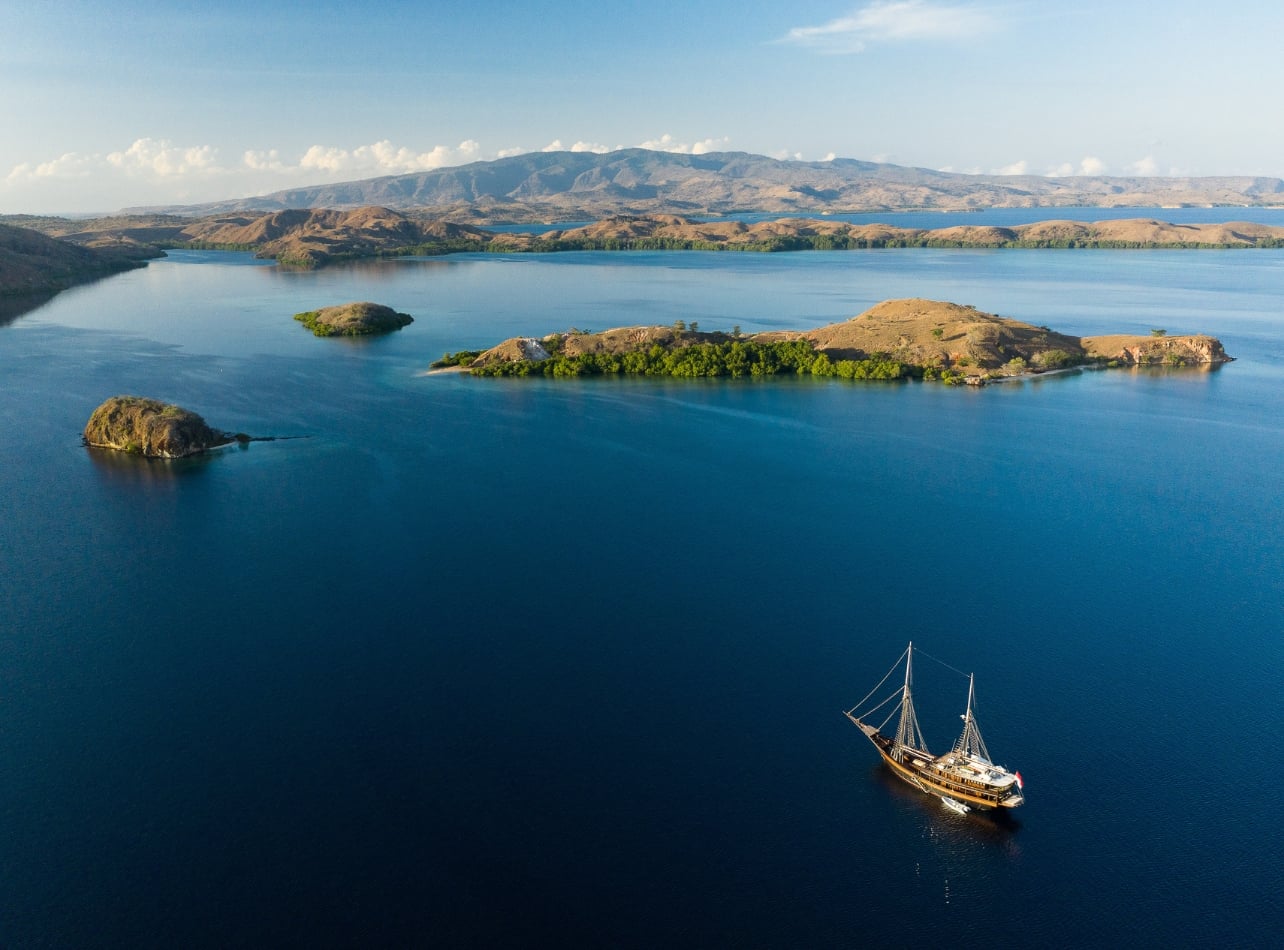
Island hop like never before aboard Dunia Baru.
Mark Robba is uncompromising whenever he tackles a project. The New Englander, a manufacturing entrepreneur who has lived in Indonesia for almost four decades, is a seasoned salt, and nothing makes him happier than being out on the water. When he remarried in 2005, Robba initially planned to build a new family home, but instead pivoted to his passion for sailing. He approached it with that same obsessive pursuit of excellence.
No wonder Robba wouldn’t settle for one of those thrown-together runarounds that are so commonplace around Southeast Asia—wooden skiffs more than yachts. Instead, he resolved to build an unrepeatable vessel: a superyacht that would be as much a work of art as a workhorse on the ocean. The result was Dunia Baru.
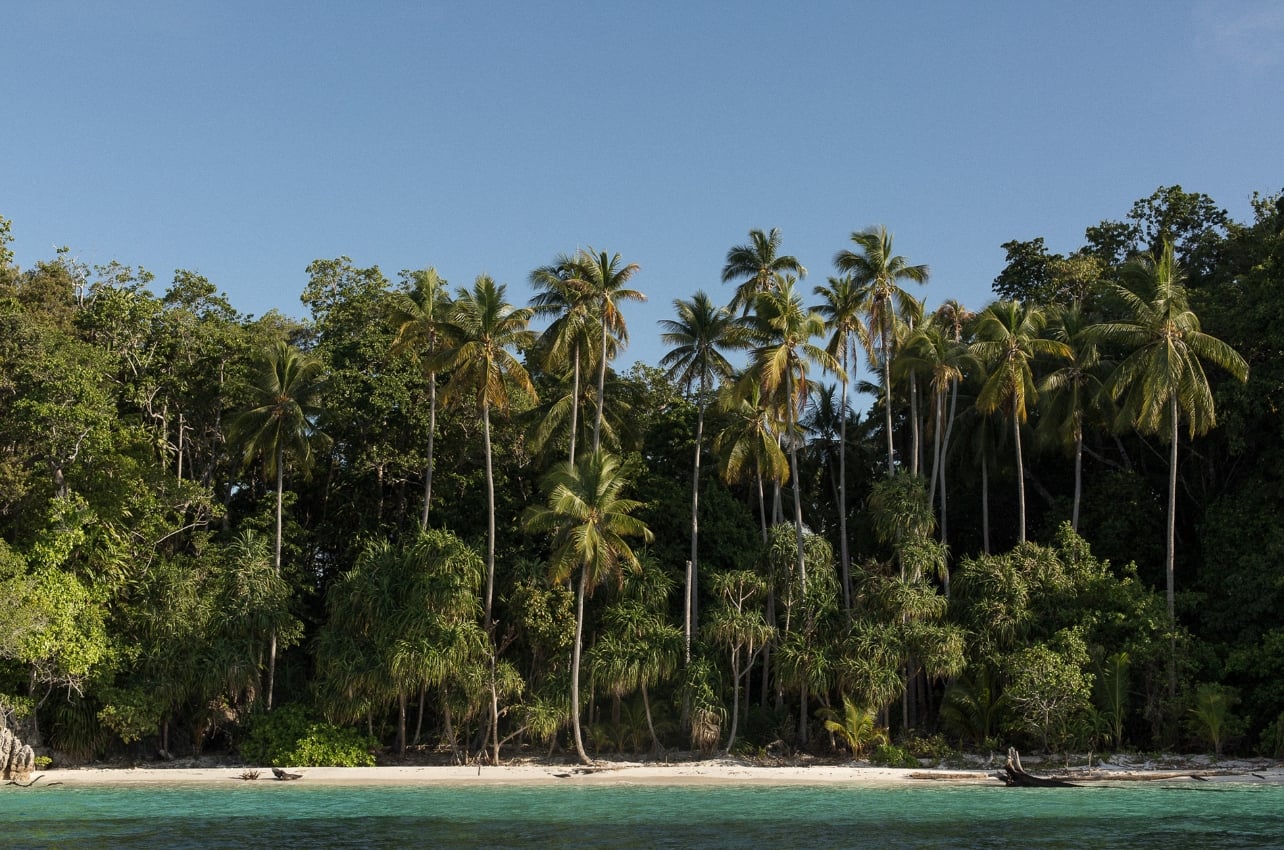
An idyllic stretch of coastline on Raja Ampat.
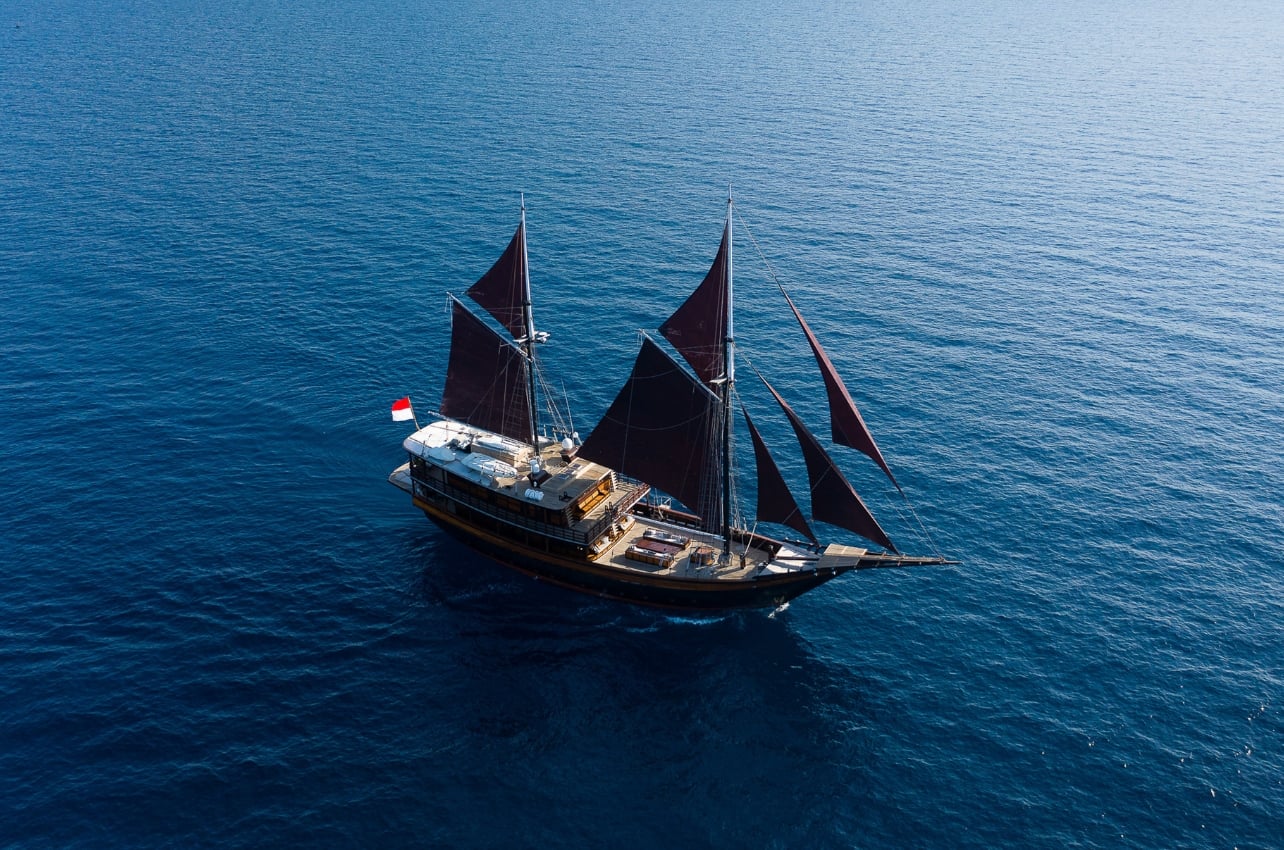
Today, that 167-foot yacht remains unmatched on Indonesia’s waters and will likely always be a one-of-one. Wooden boats, or phinisi, are a familiar sight in these locales; their dark teak hulls stark against the bright blue water, bobbing with anchors dropped in isolated bays. Many are simply built, aimed more at keen divers wanting a convenient perch from which to reach untrafficked reefs, with few luxuries.
Dunia Baru can reach those reefs, too—but the experience of doing so on this extraordinary vessel is unlike any other, anywhere. It’s fitting that the name means “New World” in Bahasa Indonesia. It’s also only offered for charter for a few months a year to cruise around the Jurassic Park–like islands of Raja Ampat, or go seeking sight of the dragons in Komodo.
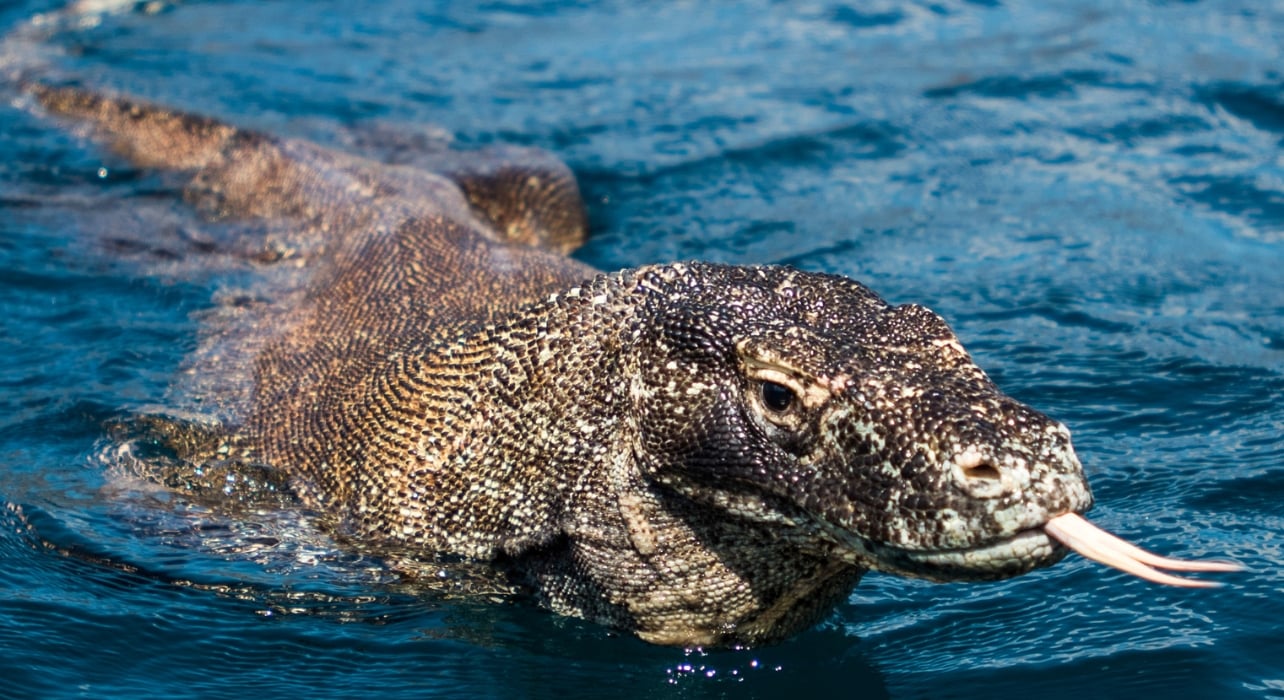
An excursion to the island of Komodo promises sightings of its famed namesake dragon lizard.
Phinisi were originally built to service the global spice trade in the 19th century, ferrying nutmeg and mace from these shores so that Europe’s demanding aristocrats could scatter them on banquet tables. In recent years, though, they’ve been co-opted as leisure vessels, whether operating for charter or as shared liveaboards. Most are quickly built, requiring no more than three years from start to finish. It required almost eight years and millions of dollars—not to mention patience—to achieve Robba’s dream.
First, he hired Michael Kasten, the American naval architect who also designed the Aman-operated Amandira, to supervise the project. Building began in rural Kalimantan, known for its shipwrights. Robba went up dozens of times to see it under construction from his base in Jakarta. Once the hull was finished, it was handed over to another team to complete the interiors. Everything was built in full-scale mockup so that craftsmen could follow more than on-paper plans. (Three of those who helped build it remain onboard today as part of the maintenance team.)
It’s a remarkable achievement—not least because the entire structure is made from wood, whether the planks of the deck or even the hinges on the doors. Look closely and you’ll understand the painstaking thought behind the process: the hinges use curly-grained teak, which doesn’t crack as easily under strain. The keel is a single, almost 115-foot–long trunk of ironwood, a tree that grows about one-tenth of an inch a year—prized for its density, durability, and resistance to fire, water, and insects.
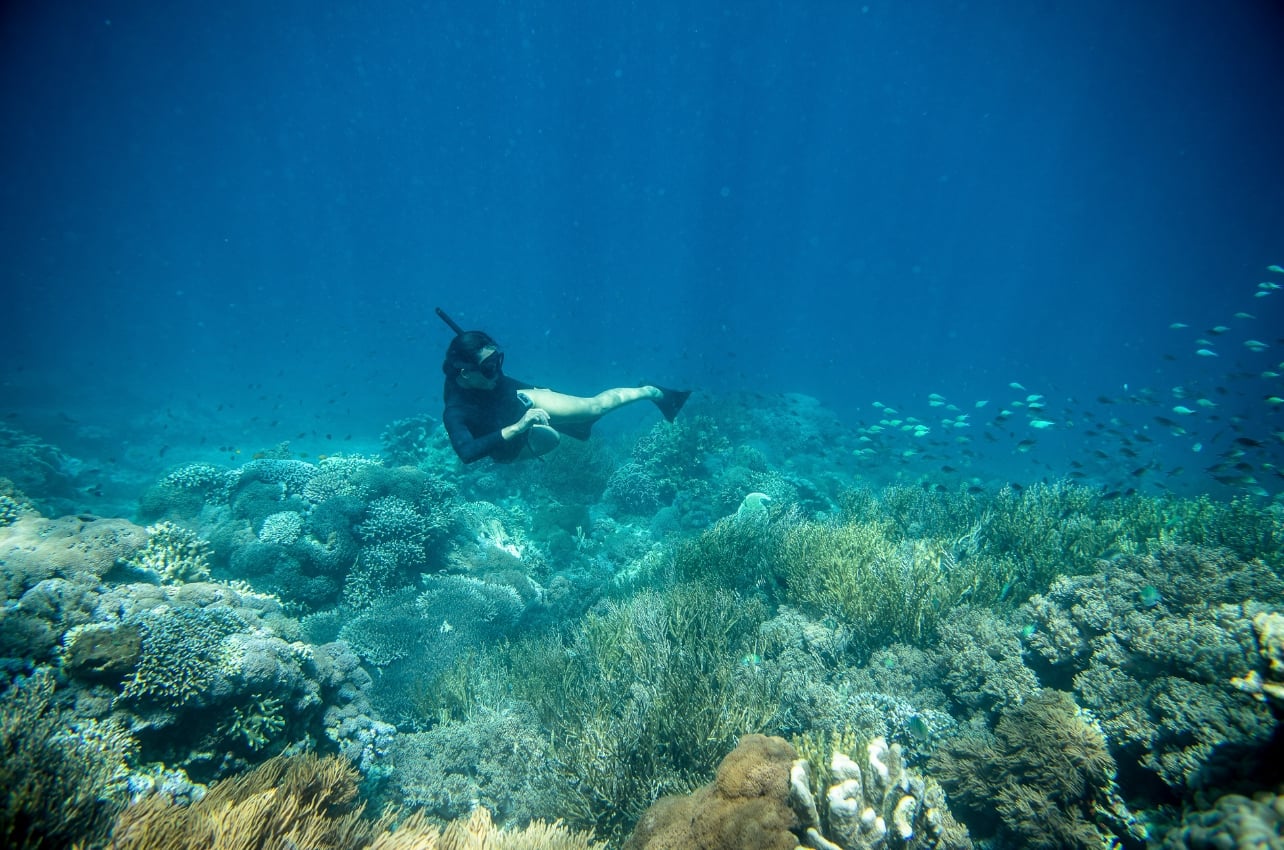
Snorkeling the reefs off the island of Pulau Yanggelo.
Dunia Baru isn’t just beautiful, but also a stalwart, able to hit 12 knots at top speed. And its artful construction doesn’t curtail modern comforts. There’s an ice bath on the highest deck, a nod to the latest wellness fad, while an exercise bike is onboard because architect Norman Foster once chartered the boat and requested one. Among the seven guest cabins, the standout is the 484–square-foot primary suite on the upper deck overlooking the stern, with dual vanities, a sitting area, and a private outdoor patio—the perfect spot for an al-fresco massage from the onboard beauty therapist. The other six cabins are more modest and sit below deck, but still have en suites and portholes framing the crashing waves.
Dunia Baru can drop anchor off almost any island, so you can choose whatever adventure appeals. Perhaps it’s kayaking through the mangroves on Pulau Yanggelo, the water shimmering in the sunshine, a deep turquoise blue. Then you can plunge into the same bay to snorkel among reefs teeming with fish so close to the surface it’s hard to resist reaching out. Perhaps instead you’d rather scuba among the rays, picking up a permit first from the ranger station off the island of Piaynemo.
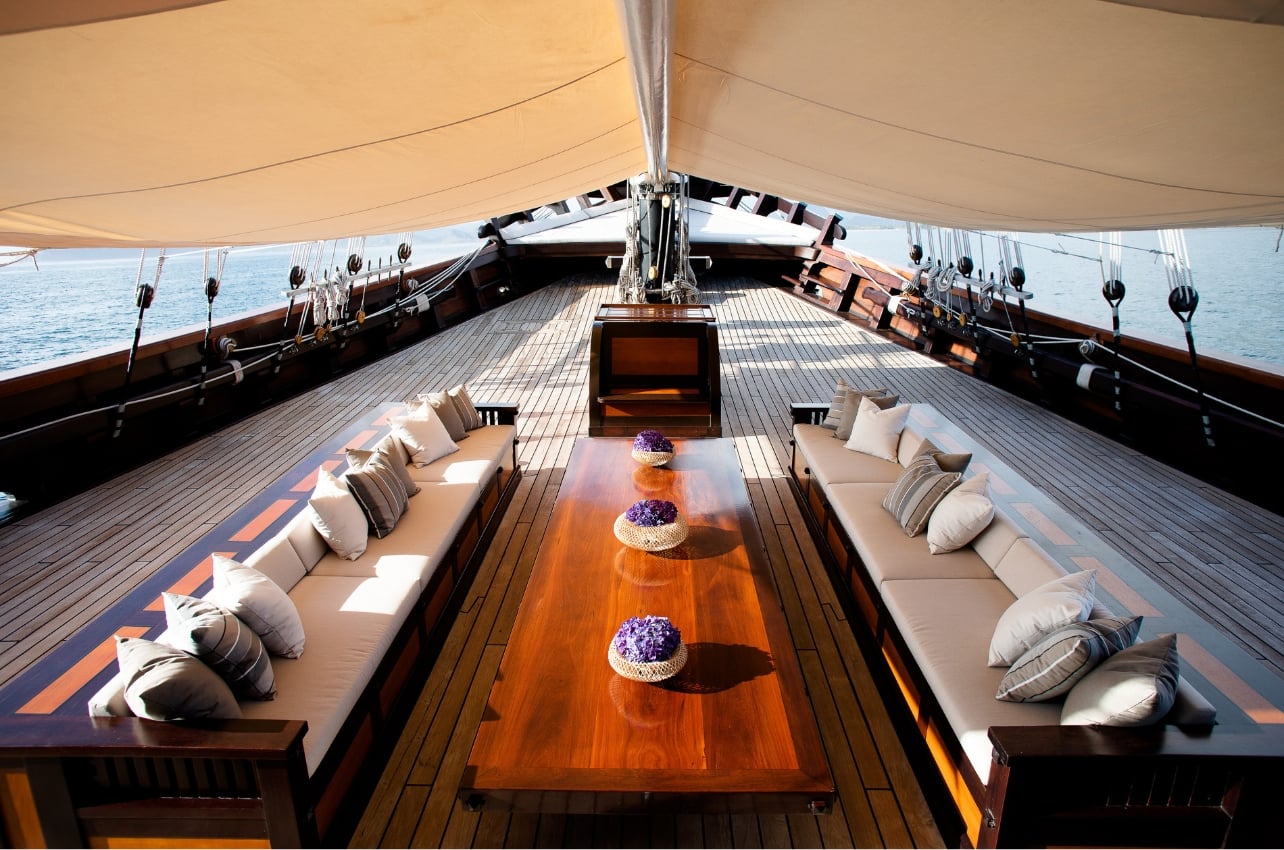
Weekly rates for Dunia Baru start at around $140,000.
Don’t worry about the weather, either. When it rains, the lush greenery of these mostly uninhabited islands sharpens. Clamber up shiny, slightly slippery wooden steps in the drizzle and you’ll be rewarded with a view of Piaynemo’s Bay, studded with green, furry islets that look newly born. On another rainy afternoon, it’s worth staying onboard for the chef to offer an ad-hoc sambal-making class, with dish after dish of peppers and tomatoes ready to sauté into that spicy condiment—so moreish it’s delicious on anything.
Sundowners on the deserted beach of aptly named Bat Island come with russet and golden reflections on the water, as cauldrons of bats begin to soar above the treetops. A nighttime dinner on another beach, this time on Pulau Yefnabi, features an entire feast set up from scratch, food cooked fresh over fire and capped off with a fireworks display that pierces an inky sky.
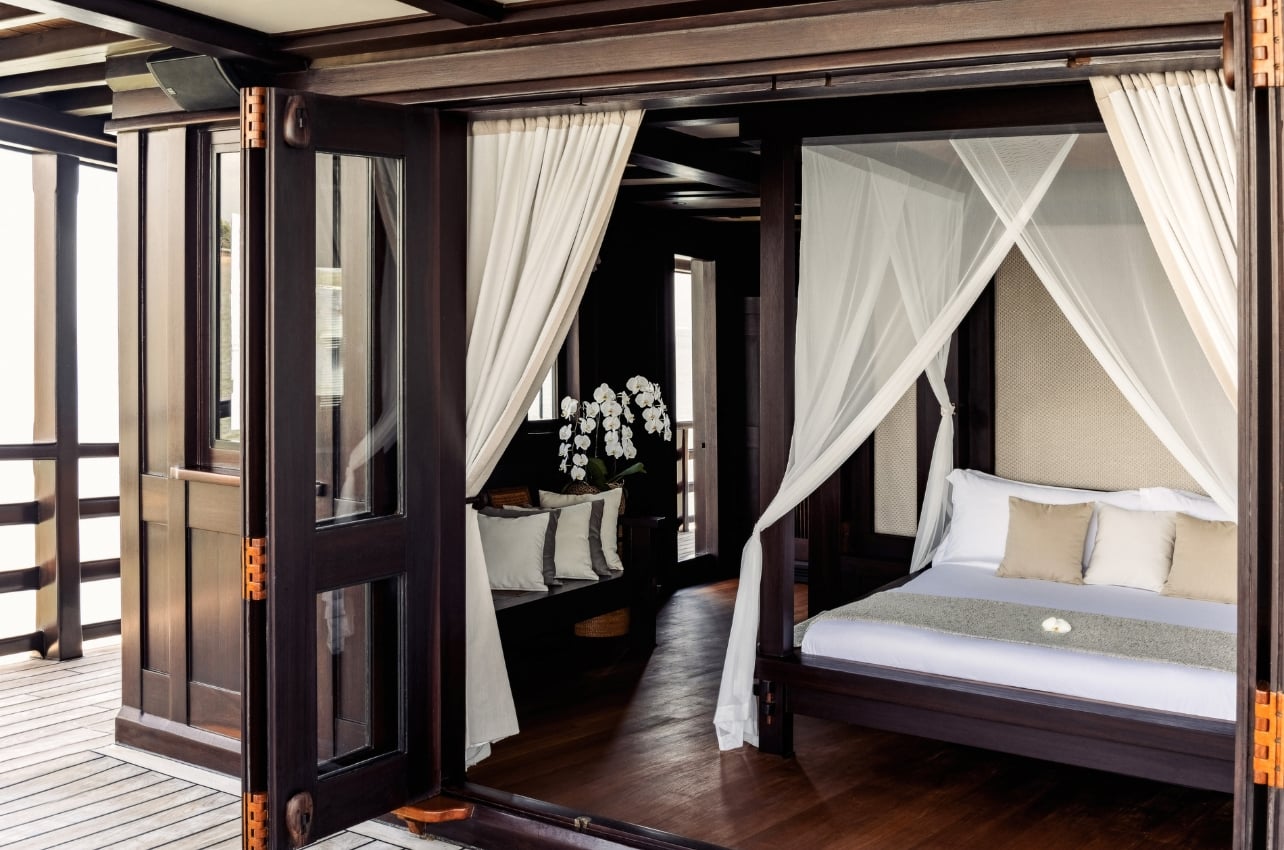
The master bedroom of the primary suite on the upper deck.
The voyage isn’t completely without human presence, though. Some islands are inhabited, like Pulau Mansuar, where the kids from one village, Sauwandarek, gather round to kick new soccer balls tossed into the air for them to play. A sign in the village square is a stark reminder that it isn’t easy to protect this precious island cluster in the modern world: a plastic bottle, a can, a bag and in big white letters next to each, a warning of how many years it will take to degrade.
It’s an extraordinary experience to be so immersed in nature and yet so cosseted from the hardships of far-flung exploration—one reason Dunia Baru is so popular among high-end brokers. Nikko Karki of Indo Yachts is one of them. He underscores that the quality of build makes Dunia Baru the only Indonesian vessel of its kind to effectively reach the standards of an international rival in operational safety. He loves its far-roaming ability, too.
“It can go where you need it to go. It’s really made for eating up the miles going on these long, remote trips,” he says, noting that clients who might want to take an adventurous detour to the north of Raja Ampat, for example, where few phinisis can readily reach, can easily do so on Dunia Baru. Karki also emphasizes that it’s an ideal vessel for snorkeling. “If you go deep, the colors get washed out. On the surface, they’re more vibrant,” he explains—ideal, for example, if a family group includes younger kids unable to scuba-dive.
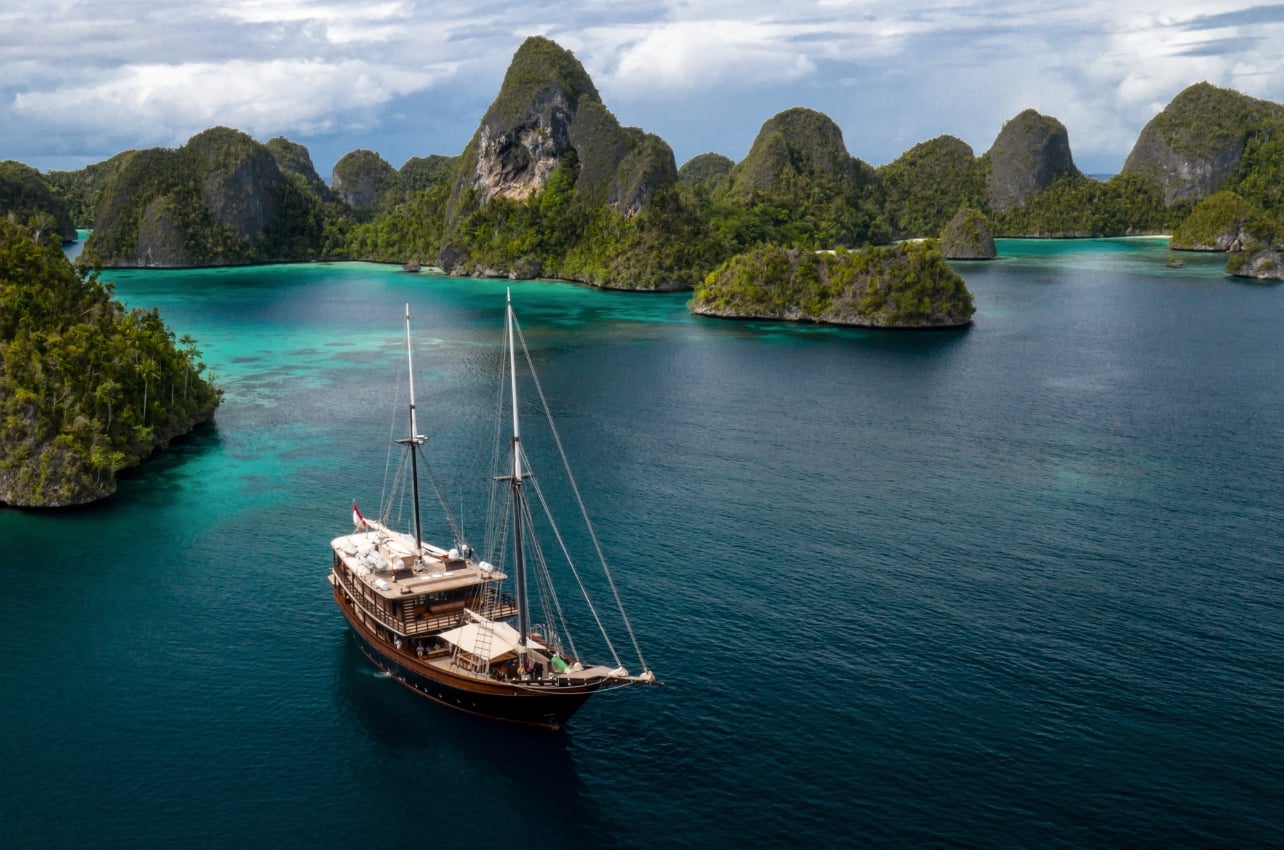
Dunia Baru is only offered for charter a few months each year to cruise in such far-flung locales as the islands of Raja Ampat, one of the world’s most biodiverse marine ecosystems.
Eleanor Bloodworth of Y.CO is another broker and enthusiast. She says that the true point of difference between this and many other superyachts of all kinds, is the staffing. Of course, service is genial and competent, but more than that, there’s a surfeit of crew members relative to day-to-day requirements, typically around 18.
“It can go where you need it to go,” says Nikko Karki of Indo Yachts. It’s really made for eating up the miles going on these long, remote trips.”
“They take such good care of you, and a lot of that comes down to manpower, as they have more than most boats that price,” she says (weekly rates for Dunia Baru start at around $140,000). Six people can be setting up, say, that beach BBQ dinner, while the rest focus on a dive afternoon, without straining capacity. Bloodworth likens Dunia Baru to a Goldilocks, just-right hybrid of those charming wooden Turkish boats and a typical superyacht. “You’re paying a little more than you would for a gulet, but getting service that’s closer to a large motor yacht.” Given the tight window each year during which it’s available for chartered sailings, she also recommends planning ahead. The family who wanted to spend New Year’s Eve on board last year booked the slot two years in advance.
In part that’s because Dunia Baru remains a family yacht as much as a commercial operation. Robba sold the boat to a past client, the Wee family from Singapore, just before the pandemic, after they contacted him about trying to build a similar vessel. He told them it would not be viable, but offered to hand over stewardship instead. He’s happy to see Dunia Baru continue to sail as it did under his stewardship, though, and he is finally focusing on his original project. “My wife asked me: Do you think someday I can have a house half as good as your boat? So I brought an architect on the boat before we sold, and asked if can design me a house half as good.” He’s happy to try, but it’s unlikely anyone could ever quite match Dunia Baru.